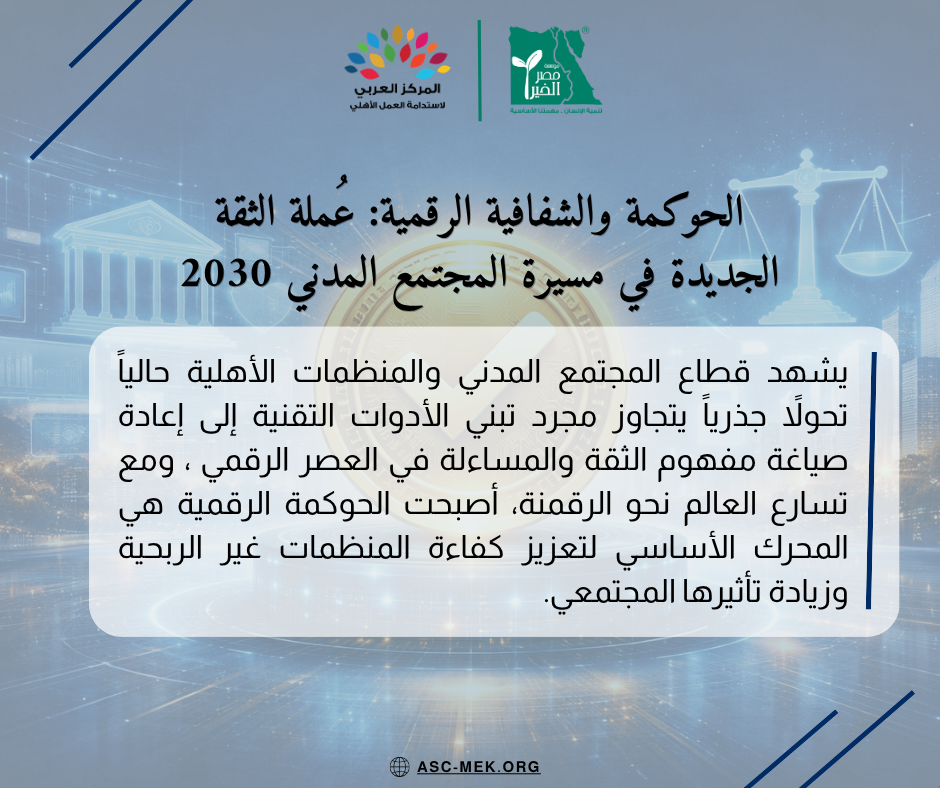
Digital Governance and Transparency: The New Currency of Trust in Civil Society Journey 2030
Digital Governance and Transparency: The New Currency of Trust in the Civil Society Journey 2030
Written by: Hamdiya Ali Noureddine
Media and Communication Specialist at Misr El Kheir Foundation
Introduction
mso-hansi-font-family: Calibri; mso-hansi-theme-font: minor-latin; mso-bidi-theme-font: minor-bidi;">The governance system within civil society organizations is witnessing a qualitative shift beyond the traditional framework based on “paper compliance” to a more mature model based on measurable operational effectiveness. General trends indicate 2025 indicates that organizations are no longer evaluated based on the existence of policies alone, but rather according to their ability to activate these policies within the daily work environment, the extent to which they are reflected in employee behavior, the efficiency of reporting mechanisms, and the speed of responding to risks and violations.From Compliance to Effectiveness: Redefining Corporate Governance
mso-ascii-font-family: Calibri; mso-ascii-theme-font: minor-latin; mso-hansi-theme-font: minor-latin; mso-bidi-theme-font: minor-bidi;">The fundamental shift in the concept of governance is the move from “documenting procedures” to “measuring their impact.”Channel usage rate Internal Reporting (Whistleblowing Systems) -And response time to complaints and violations - andLevel of employee awareness of policies mso-hansi-font-family: Calibri; mso-hansi-theme-font: minor-latin; mso-bidi-theme-font: minor-bidi;">In this context, applied institutional experiences clearly reflect this shift. The final Arab report of the governance team at the General Authority for Applied Education and Training (2024–2025) showed achieving a 100% achievement rate in integrity enhancement indicators, compared to 75% in the previous year, which reflects success in transforming governance from a theoretical framework into an effective institutional practice supported by continuous monitoring and evaluation.
Artificial Intelligence: between maximizing efficiency and complicating accountability
mso-hansi-font-family: Calibri; mso-hansi-theme-font: minor-latin; mso-bidi-theme-font: minor-bidi;">Integrating artificial intelligence into governance systems is one of the most prominent features of the current stage, as it is used in:Analysis of financial data and detection of abnormal patterns
Monitoring indicators of corruption or misuse of resources
Decision support through predictive models
mso-hansi-font-family: Calibri; mso-hansi-theme-font: minor-latin; mso-bidi-theme-font: minor-bidi;">But this technological progress poses complex ethical challenges, the most notable of which are:Algorithmic Bias: Where intelligent models may reflect inherent biases in historical data
Lack of transparency: The difficulty of interpreting intelligent systems' decisions
Data Protection: Especially in contexts of dealing with donor and beneficiary data
mso-hansi-font-family: Calibri; mso-hansi-theme-font: minor-latin; mso-bidi-theme-font: minor-bidi;">Therefore, leading institutions are moving towards adopting the concept"AI Governance" (AI Governance), which includes:Periodic review of algorithms
Establish clear policies for data use
Ensuring the interpretability of decisions
Involving the human element in sensitive decisions
Data Governance: The Backbone of Digital Trust
mso-ascii-font-family: Calibri; mso-ascii-theme-font: minor-latin; mso-hansi-theme-font: minor-latin; mso-bidi-theme-font: minor-bidi;">In an age where data is a strategic asset, data governance has become a critical element in building trust. mso-ascii-theme-font: minor-latin; mso-hansi-font-family: Calibri; mso-hansi-theme-font: minor-latin; mso-bidi-theme-font: minor-bidi;Determine data management responsibilities (Data Ownership)
Ensuring data quality and accuracy
Establish access and usage policies
Compliance with privacy standards Such as GDPRor local equivalent
mso-hansi-font-family: Calibri; mso-hansi-theme-font: minor-latin; mso-bidi-theme-font: minor-bidi;">For civil society organizations, any defect in the management of donor or beneficiary data may lead to a direct loss of trust, which is reflected in financial and institutional sustainability.Digital inclusion: a development challenge no less important than governance
mso-ascii-font-family: Calibri; mso-ascii-theme-font: minor-latin; mso-hansi-theme-font: minor-latin; mso-bidi-theme-font: minor-bidi;">Despite digital progress, it is still about style="font-family: 'Arial',sans-serif; mso-ascii-font-family: Calibri; mso-ascii-theme-font: minor-latin; mso-hansi-font-family: Calibri; mso-hansi-theme-font: minor-latin; mso-bidi-theme-font: minor-bidi;">One billion people globally are offline, which poses a challenge for organizations seeking to expand their impact.Therefore, digital transformation is no longer just a technical option, but has become linked to the concept of equity of access. mso-hansi-font-family: Calibri; mso-hansi-theme-font: minor-latin; mso-bidi-theme-font: minor-bidi;">Digital partnership strategies adopt a : approach.
Designing comprehensive and easy-to-use digital services
Supporting less accessible groups with training and capacity building
Working with the private sector to expand digital infrastructure
A practical roadmap for digital transformation in NGOs:
mso-hansi-font-family: Calibri; mso-hansi-theme-font: minor-latin; mso-bidi-theme-font: minor-bidi;">To achieve effective digital transformation, organizations need to adopt a phased approach based on the integration of technology, people and governance:Set digital goals related to the impact
mso-hansi-font-family: Calibri; mso-hansi-theme-font: minor-latin; mso-bidi-theme-font: minor-bidi;">Such as:Increasing digital donation rates
Improving the donor experience
Expanding the beneficiary base
2) Adopting the right technology
mso-hansi-font-family: Calibri; mso-hansi-theme-font: minor-latin; mso-bidi-theme-font: minor-bidi;">And not necessarily the most advanced, but the most compatible with the needs of the organization, such as:Customer Relationship Management Systems
Volunteer Management Tools
· Digital fundraising platforms
3) Building human capacity
Many digital transformations fail due to poor qualifications, not lack of tools.
This includes:
· Training employees to use the systems
· Promoting digital culture within the organization
· Empowering leaders to make data-driven decisions
4) Performance measurement and adaptation
Through key performance indicators (KPIs)Such as:
· تكلفة الحصول على متبرع جديد
· معدل الاحتفاظ بالمتبرعين
· نسبة التفاعل مع الحملات الرقمية
· زمن الاستجابة للطلبات والشكاوى
الخلاصة إن الحوكمة الرقمية الآن ليست مجرد خيار تقني، بل هي ضرورة استراتيجية لضمان استدامة المنظمات الأهلية ،ومن خلال تعزيز الشفافية الرقمية وتوسيع حيز المجتمع المدني، يمكن للمنظمات حماية بيانات المتبرعين، وتحسين الكفاءة، وبناء مستقبل قائم على النزاهة والعدالة.