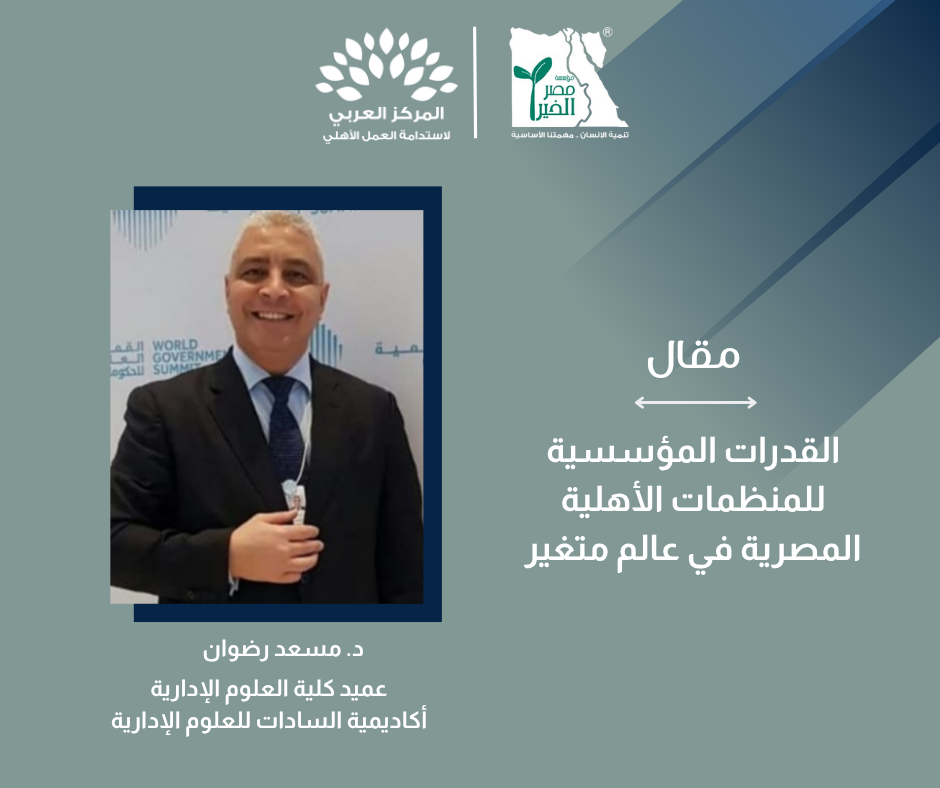
Institutional capacities of Egyptian NGOs in a changing world
Preparation / D. Musaad Radwan Abdel Hamid
Dean of the Faculty of Science Administration - Sadat Academy for Administrative Sciences
The increasing role played by civil society organizations in the world due to the changing circumstances witnessed by contemporary reality, which has formed an important input for mapping the work of these organizations. There is no doubt that changes in the nature of the political, economic, social and technological environment have led these organizations to reinvent the role they play, and to keep pace with that development, whether in formulating their vision or the work mechanisms they adopt. However, at the same time, a number of developments occurred in the world that called on civil society organizations to suddenly return once again to traditional roles, and this is no clearer than the Covid-19 pandemic, and also the emergence of some wars, conflicts and instability in some regions, which generated many repercussions not only at the level of the regions in conflict, but also other regions of the world suffering from fundamental problems such as poverty, food security, and others.
The article addresses four main axes on: the most important global trends in the work environment of non-governmental organizations, the institutional building of civil society organizations: the concept and the necessities of transformation, and institutional building For NGOs in the Egyptian case, and finally the requirements for developing the institutional capabilities of NGOs.
Many international reports indicate that the role of civil society organizations has developed globally, as the volume of work they do has increased from $288.97 billion in 2022 to $305.22 billion in 2023 at a compound annual growth rate of 5.6%, and business volume is expected to grow to $369.21 billion in 2027 at a compound annual growth rate of 4.9%, and all expectations indicate that the nature of civil society and the role of civil society organizations will change during the next fifteen years.The world is going through a number of changes that affect the work environment of civil society organizations, which require taking them into account when reinventing the role of these organizations to be more flexible and robust. (Agility & Resilient (in dealing with the future.
Interest in the implications of changing global trends and their impact on NGOs has generated a number of recent studies that rely on current data to make “state of the world” projections and identify “megatrends.” potential” in this field. These reports highlight areas of common concern such as: the consequences of climate change, the impact of resource insecurity, demographic shifts, issues related to social mobility and migration, the implications of growing economic inequality, increasing social activism and the role of civil society, changing geopolitical dynamics and the impact of new technologies and increasing connectivity of the globe through the Internet.
The various analytical reports concluded that needs are changing, the problems facing the world are changing, solutions are changing, financing is changing, and thinking is also changing. As a result, existing models of how NGOs work are no longer suitable for the new future. Civil society organizations in Third World countries face strategic challenges regarding how they deal with change and address disturbances in their external and internal environment that are likely to affect their work in the future. The most prominent of these challenges are:
First: Fundamental changes in the volume and directions of financing operations
The decline in global aid budgets is due to the trend of donors to reduce their foreign aid budgets, and the failure to prioritize humanitarian aid for many countries. Moreover, the non-profit sector faces a new challenge with the entry of many other parties such as “contractors” into the humanitarian and development field, which increases competition and makes it more difficult for NGOs to secure funding.
The landscape in which NGOs operate has changed very quickly, and therefore NGOs must be equally flexible and adaptable, especially since the business model adopted by most NGOs Whether international or national, it is more than fifty years old. Flexibility is essential for organizations to adapt to this changing landscape and be able to respond quickly to the cultural shifts occurring around them. The transformation processes in the operating environment were characterized by a number of basic aspects, including:
- Orientation towards the social enterprise model Social EnterpriseA social enterprise or social business is defined as a company with specific social goals that serve its primary purpose. Social enterprises seek to maximize profits while maximizing benefits to society and the environment, and use profits primarily to fund social programs.
Mergers and acquisitions. More than 20% of NGOs seek to assess the need for major changes in the field of mergers and acquisitions with other institutions in order to provide a more effective mechanism for developing their services. Program changes. Civil society organizations seek to bring about fundamental changes in the programs they implement, whether in terms of the method of work or the quality and form of the planned results.Third: Reconsidering the concept of capacity building
NGOs have increased their interest in building robust and flexible capacities to respond to disasters, especially before they occur. Many international reports have shown the need to search for innovative mechanisms in how to prepare for and recover from disasters in the coming years, due to the consequences that will result from climate change and other potential disasters with a significant impact on the most socially vulnerable groups.
On the other hand, civil society organizations have given increasing attention during the recent period to focusing on capacity building inputs that are concerned with developing an advanced model in the leadership of civil society organizations. Developing leadership and the work mechanism of boards of directors directly contributes to providing a strong base of support for carrying out change processes, and thus many organizations have sought to invest in leadership development. In the same context, and under the influence of scarcity of funding, the focus in the concept of capacity building and institutional building became on the search for excellence, as survival and growth became the goal of the organization depending on the extent of its ability to excel, as excellence is the only acceptable level of performance in the era of competitiveness, globalization and knowledge, and there is no survival except for distinguished organizations.
As global trends indicate, most funding agencies in recent years have focused on supporting initiatives implemented by civil society organizations that are based on building local capabilities. For example, USAID has pledged to provide 25% of its aid to local partners over the next four years, and for at least 50% of its aid to be led by local communities by the end of the decade. In addition, Finland and Denmark now require NGOs to demonstrate how their projects build local capacity in recipient countries.
The concept of institutional building is still a relatively recent terminology in the field of NGOs, and a review of the various literature indicates a degree of overlap between the concepts of capacity building and institutional building. The overlap is primarily due to the lack of literature that has analyzed and studied the two concepts.
Institutional building processes are characterized as broader and more comprehensive than capacity building processes, as capacity building processes focus on helping the civil organization to implement specific activities and programmes, often building programmes. Capacities are planned by funding agencies or donors, and directed towards NGOs implementing programs and activities. Capacity building programs aim to help the civil society organization play the role of implementing the programs without focusing on the real role as an actor in the civil society system. The concept of institutional building introduces a new dimension to developing the performance of NGOs. Instead of paying attention to supporting the capabilities of the NGO to carry out a specific activity, the NGO is developed to become an organization within its community. The concept of an organization means that it is perceived and viewed as a major actor in the societal system that influences and is affected by it. Based on the previous proposal, the concept of institutional building for a civil society organization is broader and more comprehensive than the concept of organizational capacity building, as capacity building is one of the necessary and essential dimensions for institutionally building a civil organization, but it is not the only dimension, and therefore the concept of institutional building can be defined as:
Planned interventions implemented by the NGO, an external party, or both over a relatively long period of time, leading to the creation of an institutional position for the NGO within the community Which you work with. The civil organization is one of the main actors within society, has the ability to work independently, and is capable of sustainability and suiting the renewed needs of the target groups in order to achieve a tangible impact on people’s lives.
It must be noted that the institutional building processes of NGOs are a dynamic and changing process, and therefore it was necessary to study the institutional building requirements of each NGO according to the stage The age you are at. The requirements for institutional building in the construction and growth stage may differ from the continuity stage, and this differs from the expansion stage. Various literature points to five main components of the institutional building process that must be developed and developed within the NGO so that it has an institutional position within the community in which it operates. They are: strategic management, organizational capacity, program management, resources, and relationships.
- Organizational capacity: refers to everything related to business management systems such as the human resources management system, the financial system, the information management system, the organizational structure, regulations, policies, and internal systems. The other.
- Program management: Program management reflects the main interventions implemented by the NGO, which constitute the main reason for its existence. In society.
- Relationship management: The NGO is considered an intermediary link between many parties (governmental, society, the private sector, and so on). Therefore, one of the important elements of the NGO’s ability is Its ability to manage relationships with various parties effectively. These relationships are represented in different types, such as partnership relationships, networking, and direct relationships for the implementation of programs and various activities.
The work environment of civil society organizations is characterized by its richness in implementing many capacity-building activities in support of those organizations. There are many parties that influence the work of NGOs in Egypt. These parties include the Ministry of Social Solidarity, the donors and financiers of Egyptian NGOs, the NGOs that assume the role of intermediary organizations (umbrella organizations), the General Federation of NGOs and NGOs, the specific federations, and the institutions and bodies implementing training activities for Egyptian NGOs.
However, analysis of the reality of capacity building and institutional building processes indicates that there is no clear and specific framework for planning and implementing institutional building strategies for Egyptian NGOs. This may be due to the fact that the concept of institutional building has not received sufficient attention, whether among employees of donor agencies, administrative agencies, or employees of civil society organizations. Therefore, the activities that are implemented to develop the performance of Egyptian NGOs - in most interventions - do not rise to the level of strategy, but they remain at the level of unrelated interventions that do not reflect coordination between the implementing agencies or coherence with a general plan to build Egyptian NGOs institutionally. Institutional building programs require relatively long periods of time, but in reality, most donors are interested in implementing short-term interventions, and these interventions are often linked to the implementation of specific activities and projects by the funder and are not linked to the overall performance of the NGO.
It is also worth noting that monitoring and evaluating institutional building processes has not been a priority for those working in the field of NGOs, although monitoring and evaluation processes, if well implemented, help In improving institutional building interventions and establishing changes within the civil society organization. It also helps resolve the problem of some NGOs’ refusal to invest in institutionally building NGOs under the guise that all efforts should be directed directly to the beneficiary. This is because follow-up operations clearly demonstrate the impact of development processes and institutional building of civil society organizations on community development.
The degree of interest in following up on capacity processes and institutional building varies according to the objectives of the monitoring and evaluation processes and the entity in charge of that. We find that in the case of donors, monitoring and evaluation processes are more concerned with reviewing the plans and goals agreed upon in the context of the grants given to the NGO. While the monitoring and evaluation processes of the administrative body - the Ministry of Social Solidarity - represent a method of control, and there is less interest in monitoring and evaluation processes as a way to learn from past lessons and repurpose the outputs of the monitoring and evaluation processes as new inputs to the processes of developing the performance of the civil organization.
A. Supporting and disseminating the concept of institutional building- تشجيع المزيد من الدراسات الأكاديمية، الأبحاث العلمية، والمؤتمرات لدراسة مفهوم البناء المؤسسي. وتوثيق الخبرات الناجحة في شكل قصص نجاح، أو حالات موثقة بحيث يمكن استخدامها لإدارة المعرفة وزيادة التراكم المعرفي والخبرات الخاصة بعمليات البناء المؤسسي بقطاع المنظمات الأهلية.
- صياغة خريطة عامة لاحتياجات المنظمات الأهلية المصرية، سواء من حيث الاحتياجات الفنية أو الاحتياجات الجغرافية واستخدام تلك الخريطة لتوزيع مجهودات برامج البناء المؤسسي بشكل منطقي سواء من حيث التركيز على جوانب معينة في أداء المنظمات أو إعطاء أولويات لمناطق جغرافية معينة. أيضا تستخدم نتائج ذلك لتقييم أداء القطاع ومدى التقدم في قدراته ودرجة مؤسسيته كأحد الفاعلين الرئيسيين في المجتمع المدني المصري.
- أن تتبنى الجهات المانحة والمنظمات الأهلية الكبيرة والتي لديها خبرة للعمل كجمعيات مظلة أو وسيطة مجموعة من الإصدارات (كتب أو مجلات أو مطويات) تهدف إلى شرح مفهوم بناء القدرات المؤسسية للجمعيات الأهلية. وأيضا تنظيم الجوائز والمسابقات في هذا المجال لتكون بمثابة دافع للجمعيات الأهلية للتوجه نحو تعزيز القدرات المؤسسية.
- التأكيد على أن يتم بناء المنظمات الأهلية مؤسسيا من خلال تبني استراتيجيات طويلة المدى، وليس مجرد تدخلات متفرقة، بل مرتبطة برسالة المنظمة ودورها كفاعل في المجتمع أو قطاع المنظمات الأهلية.
- أن يتم إنشاء مراكز تدريب وبناء قدرات متخصصة على المستوى المحلى، تساعد في تنفيذ أنشطة البناء المؤسسي بدلاً من الاعتماد على مراكز التدريب والدعم الفني الكائنة بالمدن الكبيرة. وقد تأخذ مراكز التدريب والدعم الفني المحلية أشكالا متعددة منها أن يتم اختيار جمعيات أهلية من نفس المنطقة لديها خبرة وقادرة على تقديم الدعم الفني وإعداد تلك المنظمة وتزويدها بمفاهيم العمل كمنظمة وسيطة وتبني فكرة مساعدة المنظمات الأهلية الأخرى الأقل قدرة.
ب. تبنى نمط القيادة الاستراتيجية التحويلية
تحتاج المنظمات الأهلية لنمط جديد من القيادة، لا يهدف فقط إلى الإنجاز، بل تحدى الواقع واستشراف نموذج مستقبلي جديد للمنظمة وهو ما جعل العديد من المنظمات تبحث عن نموذج القائد المتوجه نحو القيمة Enterprise Leadership والقائد التحويل Transformational Leadership، ذلك أنه يحقق العديد من المزايا منها تحدى الواقع، وأيضا بناء شراكات استراتيجية، أي أنه يتوجه نحو البيئة المحيطة ويتفهم ما هي علاقات القيمة المضافة.
ويقوم القائد بدور في إيجاد ثقافة مؤسسية تدعم تحقيق التميز وتحفز العاملين على التطوير المستمر والتفكير الابداعي غير النمطي، لما يمثله القائد من قدوة للعاملين في جميع المجالات وخاصة في المجالات التي تتطلب التواصل مع المتعاملين ومتابعة أمورهم وتحقيق رضاهم. ولعل أهم ما يميز القائد التحويلي أن لديه القدرة العالية على تحديد أوجه القصور والفرص المتاحة، وصياغة الرؤية المستقبلية للمنظمة وإجادة التعبير عنها، وأيضاً البحث عن وسائل غير تقليدية لتحقيق الرؤية والوصول إلى الأهداف. وتوظف القيادة الاستراتيجية التحويلية في القرن الحادي والعشرين مفهوم رأس المال البشرى الذي يملك المهارة والمعرفة، ورأس المال الاجتماعي الذي يملك المصادر الفاعلة، وكلاهما مهم لتحقيق قوة دفع المنظمة والتنافسية. إن القيادة الاستراتيجية التحويلية هي المسئولة عن نجاح المنظمات أو فشلها، والقادة هم المسئولون عن تحقيق التوازن الاستراتيجي بين التطلعات والحاجات، كما أنهم المسئولون عن التميز والمنافسة، وهم الذين يتولون التخطيط الاستراتيجي، والتفكير الاستراتيجي، بهدف تطوير المنظمات.
ج. تطبيق مفهوم الإدارة المرتكزة على النتائج Results- Based Management
تعرف الإدارة المرتكزة على النتائج بأنها استراتيجية إدارية تهدف إلى إحداث تغيير جوهري في طريقة عمل المنظمات، من أجل تحسين الأداء وتحقيق النتائج المرصودة التي هي محور عملية التغيير. وتهتم الإدارة المرتكزة على النتائج بشكل فني ومحدد بتوضيح الأهداف المخططة، ووضع مؤشرات لقياس مدى التقدم في تحقق تلك الأهداف، وأيضاً جمع البيانات بشكل مستمر للتأكد من أن الأنشطة والعمليات المنفذة تسير نحو تحقيق النتائج المرجوة. ويساعد التطبيق الفعال لمفهوم الإدارة المرتكزة على النتائج على وجود نتائج محددة وهو ما يساعد في إيجاد الشعور بالمسئولية لدى العاملين بالمنظمات الأهلية، ومن ثم تولد الدافع الذاتي الداخلي نحو الالتزام بتحقيق هذه النتائج حتى لا يكون تحت دائرة الضوء فيما يخص المساءلة.
د. دعم مفهوم المنظمة المتعلمة Learning Organization
تدلل التجارب الدولية في العديد من الدول أن دعم المعرفة بالمنظمات الأهلية يعمل على دعم ثقافة التميز. وتبنى منظور المنظمة المتعلمة في توظيف عمليات التعلم يرسخ القيم المهنية التي ترعى استدامة التميز، وذلك من خلال تبنى منظومة التعلم التنظيمي الشامل والذي يمكن أن يتم ترجمته بشكل إجرائي في بناء القدرات المؤسسية للمنظمة الأهلية.
إن فلسفة المنظمة المتعلمة تتعدى مجرد الاهتمام بالموارد البشرية، وتقديم أنشطة تدريبية على درجة عالية من الدقة، ولكن هي تلك المنظمة التي تضع ضمن أولويات أهدافها تنمية العنصر البشرى، وصقله بكل المتطلبات التي تجعل منه عنصراً فاعلاً وأساسياً، يساعد المنظمة للاستجابة للتغيرات المحيطة من خلال دعم عمليات التعلم التنظيمي. إن التعلم التنظيمي يدلل على وجود درجة من الوعي المتنامي بالتحديات التنظيمية التي تواجه المنظمة، وكيفية التعامل مع تلك التحديات من قبل الأفراد داخل تلك المنظمة وبما يكون له أثر على عناصر ومخرجات المنظمة ذاتها. وتدلل الكثير من الأدبيات أن قدرة أي نظام على البقاء والحفاظ على تكامـله وتوازنه يتطلب أن يكون مستوى المعرفة الناتجة عنه مساويا على الأقل لمستوى التغير الموجود في البيئة. وبما أن المنظمة هي نظام مفتوح تتأثر بمـا يحدث حـولها، فلا بد أن يتلاءم معدل التغيير والتعلـم فيها مع معـدل التغـير في البيئة المحيطة بها.
ه. تفعيل ميثاق العميل Clients' Charter
لقد شهد العقدان الماضيان تحولات أساسية في إطار المفاهيم الخاصة بإدارة المنظمات الأهلية، فقد تحول الحديث من الإدارة والسيطرة المهنية والإدارية إلى سيادة ريادة العميل، ومن ضبط أو مراقبة التكاليف إلى إدارة الأداء، ومن زيادة كمية المخرجات إلى تحسين جودة الخدمات، ومن تقييم مدى سلامة الإجراءات إلى المساءلة عن النتائج ومستويات الأداء. ومن ثم يأتي ميثاق العميل ليدعم تلك الرؤية والمسئولية المشتركة. وميثاق العميل هو وثيقة يتم اعدادها بناءً على التشاور بشكل موسع مع المواطنين، وكادر الصف الأمامي بالمنظمات الأهلية بهدف إخبار وإعلام كافة الأطراف عن مهام المنظمة نحو الخدمات المقدمة ومعاييرها وحقوق وواجبات متلقي الخدمات، وتكاليف الخدمة، وآلية تقديم الشكاوى، وأي معلومات اخرى تتعلق بالمنظمة وخدماتها، بحيث يجعل مقدمي الخدمة أكثر استجابة لاحتياجات ومتطلبات متلقي الخدمة من خلال التشاور المستمر معهم، هذا من جهة؛ وتعزيز الحق في مساءلة ومحاسبة مقدمي الخدمة من خلال استخدام آليات مراقبة الاداء وقياسه، من جهة أخرى.
و. بناء الثقة مع المجتمع
تحتاج المنظمات الأهلية إلى الاهتمام بشكل جوهري بدعم ثقة المواطن لها في ظل المتغيرات المحيطة بها والتي تشكل توقعات متصاعدة للمواطنين، إذا لم تتكيف معها المنظمات الأهلية سوف تشكل ضغوطا عليها ومزيدا من تناقص الثقة في تلك المنظمات.
ويشير مفهوم الثقة إلى حالة من الاطمئنان من جانب فرد أو مجموعة تجاه فرد أو مجموعة أو منظمة، وتتضمن تلك الحالة الاستعداد لتحمل مخاطر تلك الحالة، في سبيل تحقيق أهداف يؤمن بها الطرف أو المجموعة مانحة الثقة. كما أن الثقة تعكس متغيرات عديدة منها السيكولوجي والاجتماعي وكذلك السياق العام والذي يمثل بيئة داعمة أو مهددة لعلاقات الثقة.
ولقد بدأت الألفية الحالية برؤية مختلفة لإدارة المنظمات الأهلية ترتكز على مزيد من الشراكة مع المجتمع، والدعوة لنظام جديد لحوكمة المنظمات الأهلية. وتضمن النهج الجديد اشتراك أكثر من طرف في تنفيذ الأهداف التنموية. يتضمن النهج الجديد أيضا العلاقات التنظيمية المتقاطعة وحوكمة العمليات المختلفة، والتي بمقتضاها فإن عامل الثقة ورأسمال العلاقات (Relational Capital) والعلاقات التعاقدية تقوم بدور مهم أكثر من مجرد الاهتمام بالشكل التنظيمي والوظيفي للمنظمة الأهلية. وقد أدى ذلك إلى المزيد من التفاعل بين المنظمات الأهلية وجمهور المواطنين، ومن ثم أصبحت تلك المنظمات متأثرة في عملها برؤية المواطنين حول الطريقة التي تقدم بها الخدمة وعما إذا كانت مناسبة أم لا، ومن ثم أضحت الثقة من قبل المواطنين من أهم العوامل المؤثرة.
ز. تعزيز مبادئ الحوكمة الرشيدة بالمنظمات الأهلية
تستطيع المنظمات الأهلية الحفاظ على الثقة مع جمهور المواطنين من خلال مجموعة من التدخلات المرتبطة بالحوكمة ومنها: إبداء الشعور الصادق والتناغم بين ما يقولونه وما يفعلونه؛ والحرص على تمثيل والتعبير عن مصالح المواطنين بشكل فعال؛ وتنفيذ اصلاحات جوهرية في نظم الإدارة الخاصة بها. ويتوقع المواطنون أن تقدم المنظمات الأهلية الخدمة بنزاهة وعدالة وأن تدير الموارد العامة بأكثر قدر من الكفاءة والفعالية، وأنها تتصف بالحيادية، والشفافية، والنزاهة، والمهنية.
ح. دعم التواصل مع المواطنين
يساهم التواصل مع المواطنين في توحيد الرؤى بين المنظمات الأهلية والمواطنين حول ما يجب فعله وكيف يتم عمله والتحديات التي يجب أن يتحملها الجميع. على الرغم من تنامى استخدام وسائل التواصل الاجتماعي، إلا أنها لم توظف بالشكل الكافي من أجل التسويق الاجتماعي للمنظمات الأهلية، ومن ثم تسارعت وتيرة الانتقادات لأداء المنظمات الأهلية – في بعض الأحيان- بما أدى إلى دعم صورة ذهنية سلبية. تحتاج عمليات التسويق الاجتماعي للمنظمات الأهلية إلى توظيف أساليب أكثر ابتكارية للتواصل مع الفئات المتنوعة من المواطنين بما في ذلك وسائل التواصل الاجتماعي المختلفة، وبشكل ليس من شأنه محاولة تحسين صورة المنظمات الأهلية بشكل دائم وفقط ولكن لإظهار الحقائق مما يخلق درجة أكبر من الثقة.